What is in this guide
School shoes verified from Australian brand listings on 12 September 2026 run from $49.95 to $169.95. That is a more than threefold spread for a black shoe worn five days a week, and understanding what it buys is most of the decision.
The short version: the spread is mostly construction and sizing range, and no listing publishes wear testing, so nobody can tell you which pair lasts a year. What you can control is fit, and fit does more for how long a shoe survives than anything on the label.
What the verified evidence covers
This is a guide, not a ranked list, and not a complete market survey. Two brands were verified from live manufacturer listings on 12 September 2026: Surefit across 23 shoes from $49.95 to $139.95, and Clarks across 20 shoes from $59.00 to $169.95. Kmart, Big W, Target, Payless and Amazon Australia block automated access, so their shoes could not be verified and are absent.
Two brands is not enough evidence to rank a market, so this article does not attempt to. Nobody at Dovelyne has worn or worn out any of these shoes.
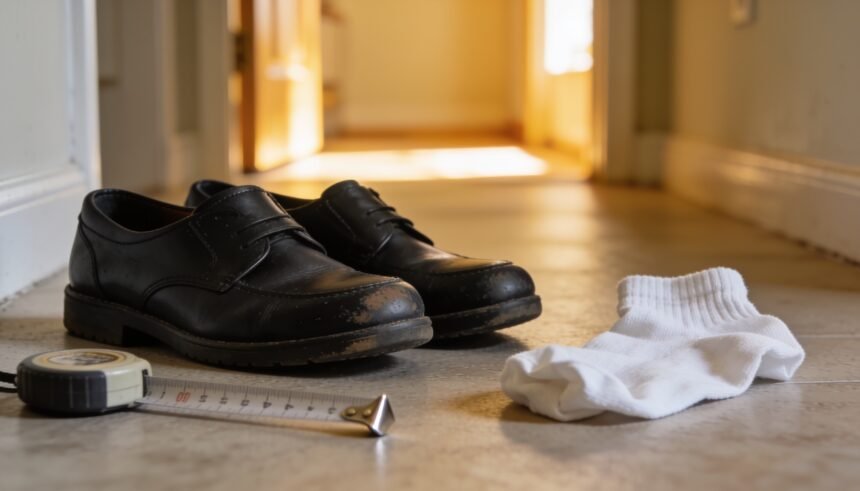
Measure the foot first, properly
This is the step that gets skipped and it is the one that matters.
Measure both feet, late in the day. Feet swell through the day and most people have one foot slightly larger. Fit the larger one.
Measure length and width. Width is the part Australian parents most often miss, and a shoe that is the right length but too narrow is the most common source of complaint by week three.
Measure with the school sock on. A thick sport sock changes the fit meaningfully.
Do it in January, not in November. Feet grow over summer and a November measurement is usually wrong by term one.
Leave growing room, but not a size. About a thumb’s width at the toe is the usual guidance. A full extra size makes the shoe slide, which causes rubbing and wears the heel counter out early.
What the price spread actually buys
Across the verified range, the differences that appear in the listings are construction, fastening and sizing range.
Fastening. Cheaper shoes in the set are self-fastening strap designs; the Surefit Ben at $49.95 is described as a unisex shoe with a double self-fastening strap for easy on and off. Straps suit younger children who dress themselves.
Padding and adjustability. The Clarks Skill at $59.00 is described as having a padded collar and adjustable touch-fastening straps to customise the fit. Adjustability is a genuine functional difference, because it accommodates a wider range of foot shapes.
Senior sizing and materials. The top of the verified range, the Clarks Daytona-Detroit Senior at $169.95, is described as designed for older kids and crafted in premium black leather. Senior sizing and leather construction are where the price concentrates.
What the listings do not state anywhere: expected wear life, sole durability, resole-ability, or any test result. So while it is reasonable to expect a leather senior shoe to outlast a $50 strap shoe, that expectation is not coming from published evidence and this article will not present it as though it is.
Leather, synthetic or a sneaker-style shoe
Leather moulds to the foot over a few weeks and generally polishes back. Costs more and is heavier.
Synthetic is lighter and cheaper, wipes clean rather than polishing, and does not mould.
Sneaker-style black shoes are increasingly accepted by Australian schools and are what several of the verified shoes actually are. Check your school’s policy first, because many specify black leather and some explicitly exclude sneaker profiles.
None of these is better in general. They are different trade-offs, and your school’s uniform policy may make the decision for you.
Making a pair last
Fit does most of it. These do the rest.
- Two pairs, alternated, if the budget allows. Shoes that dry fully between wears last considerably longer, and this is the single most effective thing on this list
- Keep sport shoes separate. School shoes worn for running at lunch wear out at the toe first
- Polish or wipe weekly. Leather that dries out cracks at the flex point
- Check the fit each term, not each year. Feet grow mid-year and a shoe that has become tight wears strangely
- Replace the laces rather than the shoes where laces have gone
What to check in the shop
Since no listing publishes durability, the assessment happens in store.
- Press the heel counter. The stiff cup at the back should resist. Soft ones collapse and the shoe loses shape
- Flex the sole. It should bend at the ball of the foot, not in the middle
- Feel inside for seams at the toe and heel where rubbing starts
- Have the child walk, not stand. Standing tells you almost nothing
- Check the width fastening has room to adjust in both directions
On foot health
If your child reports pain, if the shoe wears very unevenly, or if you have a specific concern about their feet or gait, that is a podiatrist conversation. This article is about buying a school shoe and makes no claim about foot development, arch support or what any shoe does for a child’s feet. No product listing in the verified set makes such a claim either.
Before you buy
Check the school’s policy. Many Australian schools specify black leather and some exclude particular styles.
Buy in January after measuring, not in November against last year’s size.
Check the current price. Prices here were read on 12 September 2026 and this category discounts heavily in January.
Next: the back to school checklist covers the timing, the year-by-year shopping list covers the rest of the list, and what back to school actually costs per child puts the shoe spend in context.
Pick 1
Surefit Ben Black School Shoes
Surefit
The one-page family week
One printable page that holds the whole week: meals, school, activities and who is doing the pickup. Free, and we send one useful email a week.
One email a week. No spam, unsubscribe in a click.