What is in this guide
Start with the finding that shapes this whole article. Across the Australian school bag listings verified for this piece, not one publishes a strap width, a back panel construction, an empty weight, a capacity in litres, a load rating or any ergonomic measurement. The nearest thing to an ergonomic claim anywhere in the set is one brand describing its large backpack as “lightweight to carry”, which is marketing language rather than a specification.
That matters, because every roundup in this category ranks bags on how well they carry. On the published evidence, nobody can do that honestly, including this article.
So this is a guide to what the features do and how to fit a bag, not a ranked list. Where a real answer does not exist, it says so.
What the evidence actually covers
Four backpacks were verified from live Australian manufacturer listings on 12 September 2026, across three brands and three size classes: mini at $49.00 and $59.95, midsize at $39.99, and large at $74.99. This is not an exhaustive survey of the Australian market, and the prices were read from those listings on that date.
Nobody at Dovelyne has worn or loaded any of these bags. The verified data supports price, size class and what each brand states about its own product, and nothing more.
What each feature is for
None of these is ranked here. This is what the feature does when a bag has it.
Two shoulder straps, used together. The single most consequential thing, and the one that depends on the child rather than the bag. A bag worn on one shoulder loads one side. No design fixes that.
Padded straps. Spread the pressure across a wider area of the shoulder rather than concentrating it under a narrow strap edge. Wider and thicker generally spreads more. None of the verified listings publishes strap width, so you are assessing this by hand in a shop.
A sternum or chest strap. Holds the shoulder straps in position so they do not slide outward under load. Common on larger bags and hiking packs, rare on Australian primary school bags, and absent from every verified listing here.
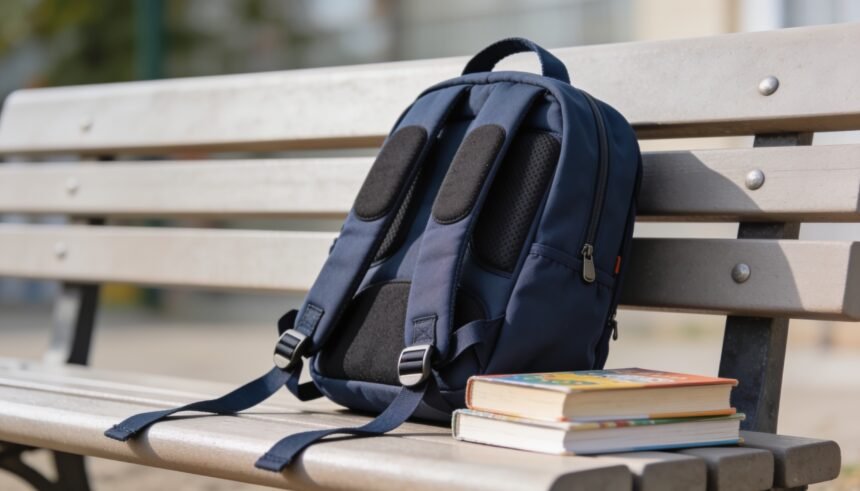
A padded back panel. Stops the contents pressing into the back and adds a little structure so the load sits against the body rather than sagging away from it. A bag that sags pulls backwards, which is why a full soft bag feels heavier than a structured one of the same weight.
A structured or framed base. Keeps the load sitting high and close rather than settling into the bottom of the bag. Cheap unstructured bags settle, which moves the weight away from the spine.
Compression or side straps. Stop contents shifting around inside. Movement is what makes a bag feel heavier than it is on a walk to school.
Multiple compartments. Distribute weight rather than letting everything collect in one corner. The largest verified bag states three large compartments, which is a genuine layout difference rather than an ergonomic claim.
A waist strap. Transfers load to the hips. Standard on hiking packs, essentially absent on Australian school bags.
How to fit a bag, which matters more than which bag
Fit is free and is the part parents can actually control.
- Both straps on, every time. This outweighs every design feature on the list.
- The bag sits between the shoulders and the waist, not down near the hips. A bag hanging low pulls backwards and the child leans forward to compensate.
- Tighten the straps so the bag sits against the back. A gap between bag and back is where most of the discomfort comes from.
- Heaviest items closest to the back, not against the outer wall.
- Pack it, then lift it. If the child cannot put it on without swinging it, it is too heavy for them today regardless of the bag.
On weight limits
You will see a rule of thumb that a school bag should not exceed a percentage of a child’s body weight. Figures circulate between about 10 and 15 per cent, they differ between sources, and none of the verified product listings states a load limit.
This article does not give a number, because the number would not be coming from the evidence in front of it. If your child’s bag load is a genuine concern, that is a conversation with your school about what has to travel daily, and with a health professional if your child is reporting pain. It is not a question a product listing can answer.
What actually reduces the load
More effective than any bag feature, and available to everyone:
- Ask what genuinely has to come home. Many Australian schools leave textbooks at school or run digital versions, and parents often do not know
- A locker, where the school has them
- Removing what has accumulated. Most full school bags contain a term of unrequired paper
- A drink bottle filled at school rather than carried full from home
- Two lighter trips where the timetable allows
What to check in the shop
Since the listings publish nothing, the shop is where the assessment happens.
- Press the straps. Thin foam compresses flat under a thumb. Denser foam resists
- Check the strap join. The seam where strap meets body is where bags fail
- Feel the back panel. Flat single-layer fabric offers no structure
- Load it. Put books in it in the shop and have the child wear it
- Work the zips. A stiff zip on an empty bag is worse on a full one
The honest summary
Fit and load matter more than features, features matter more than brand, and brand is the only one of the three that Australian product listings tell you anything about.
Next: best backpacks for prep and kindergarten is the verified shortlist for the youngest years, what actually goes in a prep bag covers the load, and the back to school checklist covers the timing.
Pick 1
Surfing Kangaroos Midsize Kids Backpack
Alimasy
Pick 3
ONYX MINI BACKPACK
Little Renegade Company
Pick 4
Lilac Gingham Mini Daycare/Toddler Backpack
Kinnder
The one-page family week
One printable page that holds the whole week: meals, school, activities and who is doing the pickup. Free, and we send one useful email a week.
One email a week. No spam, unsubscribe in a click.